

Women’s Stories: From the Margins to the Heart of History
- Jawhara Al-Subhi
- Sep 26, 2025
- 3 min read
By Jawhara Al-Subhi
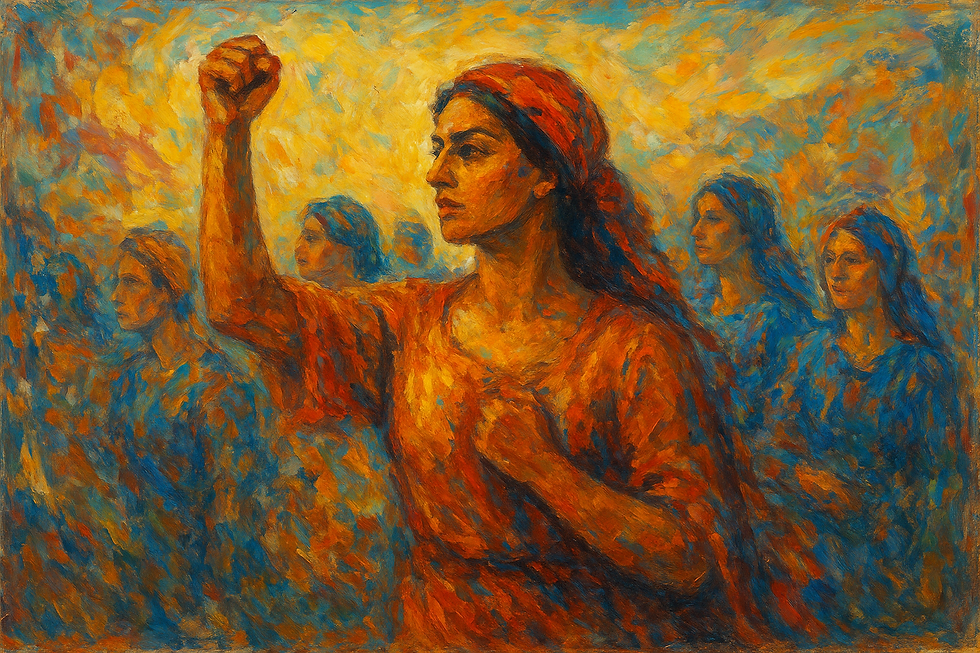
Since the dawn of history, women have been at the heart of civilization-building, yet they have long endured marginalization and deprivation of even the most basic rights.
Still, they were never absent from the stage, they are not merely the center of the universe; they are the universe itself. Symbols of strength and beauty, women transform pain into energy, wounds into opportunity. They are not fleeting figures in the hustle of life, but stories that echo through generations, shining as light or fire, either way, they illuminate.
Fear does not touch a woman who knows her worth and understands that her reflection in the mirror is not a static image, but a constant promise to rise stronger each time. She is the root anchoring the tree to the earth, the wing lifting it to the sky, the beginning and the continuity all at once.
Across the ages, societies have often tried to silence her voice, denying her education, inheritance, and participation in decision-making. Yet history could not erase her presence. Queens, reformers, poets, and scientists have left indelible marks on the world, from Cleopatra and Queen Bilqis to Helen Keller, from women who led armies to those who inspired nations with their pens and ideas.
In recent centuries, women's voices have grown louder, as movements demanded education, the right to vote, political participation, and equality before the law, changes that are still unfolding.
Today, despite remarkable progress, the path remains fraught with challenges. Girls fill universities, women occupy high offices, and they wield significant economic, artistic, and media influence, but wage gaps persist, stereotypes still constrain dreams, violence haunts homes, streets, and workplaces, and political representation rarely reflects the true scale of their participation.
Yet empowering women remains a cornerstone of any serious developmental project. Educating women raises awareness, improves public health, reduces poverty, boosts economic productivity, and ensures more just and balanced decision-making.
Laws alone are not enough. Even if legal texts change, culture is the broader battlefield. We need media that highlights successful role models rather than reinforcing dull stereotypes, initiatives that encourage girls to enter science, technology, and politics, and support for small businesses led by women to create tangible change. Most importantly, we must recognize that women’s stories are not marginal, they are the very fabric of life.
A woman given the doors of opportunity can reshape the future entirely. Granting her the right to dream is enough for that dream to become reality. She builds, dismantles, rebuilds, gives without expectation, teaches without reward, and endures without complaint. Honoring her is not celebrating an individual alone; it is honoring history and the future simultaneously. If society is a mirror of its members, it cannot be complete without reflecting the woman with dignity, freedom, and justice.
Upholding her rights is not just a moral duty, it is an investment in our shared humanity and a guarantee that life becomes broader and brighter for all.
In the Arab world, particularly, women’s voices have amazed the public with their ability to represent millions who had no platform. Journalists, writers, artists, and activists have proven that when women are given space, they create miracles. Their voices are signposts along a long road still awaiting those who will continue the journey.
The issue of women’s rights is not only a women’s issue; it is a human issue that concerns everyone who believes in justice. A society that upholds women upholds all its members. It is time to move beyond talking about “granting” women their rights and recognize that these rights belong to them inherently, and our collective responsibility is simply to remove the barriers. The more we uphold women, the more we shape a future that is just and humane for all.
Jawhara Al-Subhi, 17, writer and podcaster, is passionate about shedding light on social and cultural issues and promoting the values of human justice.
The opinions expressed in this article are solely the author’s and do not represent the views of Nisaba Media.


Comments