

Paper Boats: Children of the Mediterranean Between Dream and Death

By Doaa Bousboulah

What should I write about? For days I couldn’t decide, there’s simply too much pain stretching from Tangier to Jakarta. Our Palestinian heart is still bleeding; in Gaza, the bleeding has only worsened, and we haven’t even given her a single bag of blood.
Then I come across a video of teenagers, no, children, aboard a small boat crossing the Mediterranean toward Spain. At first, you can’t believe it. You think: it must be fake, a rumor, a clip generated by artificial intelligence. But once you verify the source and see it reported by multiple credible outlets, you’re forced to admit it’s real.
This scene isn’t new to me. I’ve heard it many times from my own students. I teach biology in middle school, and these children are the same age as the ones I teach. Whenever we open up space for discussion at the end of class, and sometimes in the middle, about their dreams and future, I’m shocked, even terrified, by their passion for migration. They speak of it in all its twisted forms, and I quickly try to change the subject after a long and heavy exchange.
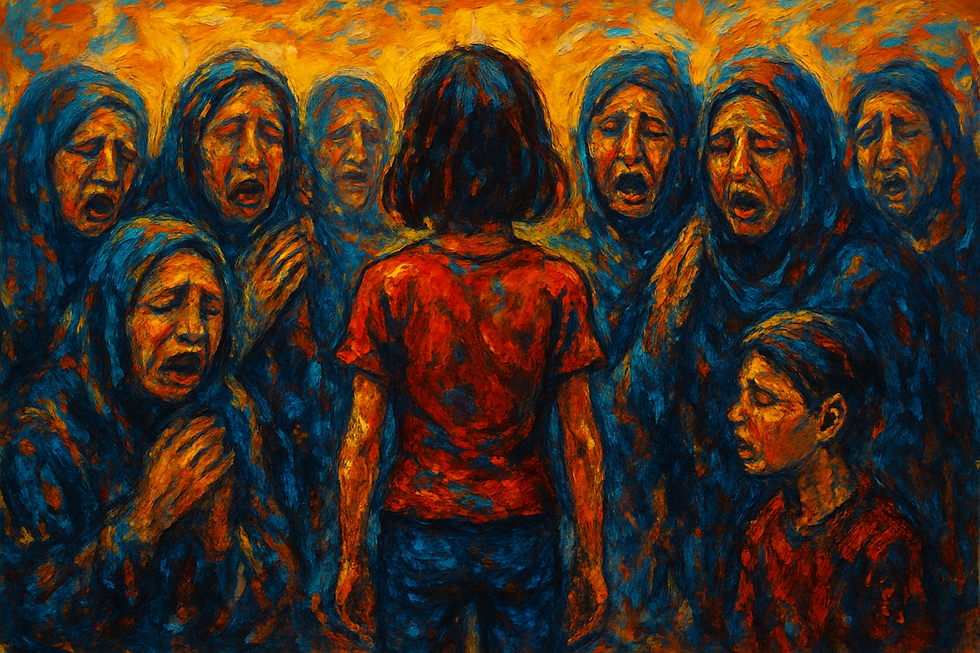
I see in their eyes a fierce longing. They call these boats “vessels of hope, life, and salvation,” while I call them “boats of death.” Yet my words make no difference, they never do.
I don’t ask, and I doubt anyone does, why our youth, even our children, risk their lives on these boats of death. The reasons are obvious to all of us. The real question is: until when?
How long will our youth and children keep boarding these boats? How long will they walk knowingly toward death under banners of “dreams” and “future”? Since when do children think about their future so gravely that they choose such perilous paths? How can a child fear unemployment this much?
They rented a boat with the intent to steal it, carrying fuel with them. They said they used a mobile app that guided them step by step, claiming they knew the sea well and had worked in it for years. It was their second attempt after the first had failed.
Other children watched this “heroic” act, and that’s the real tragedy. They saw what looked like “success” and turned it into an example, a justification, a story to emulate. The image of “heroes” etched itself into their peers’ minds.
Try to reason with them now. They’ll tell you confidently: “But they made it. They reached Europe. They’re heroes!” What a painful kind of logic.
Now, we’re hearing about similar attempts by other children, with search operations ongoing in the province of Oran.
Of course, legal migration can be a beautiful thing. It opens doors, broadens perspectives, and enriches one’s experience. But these “paper boats” are something else entirely, a bitter reality reflecting the despair of youth in their own countries, those same countries that chant “Youth First.”
So who is responsible? The state alone? Or is it a shared crime, one divided among the family, the school, and even the harraga (the term for illegal migrants who “burn” their documents)?
Especially since those most vulnerable are the homeless, school dropouts, and drug users.
Is this a family problem? A matter of education? A social issue? An economic one? Or, before all else, a national crisis?
When dying on a European shore becomes more desirable than living in one’s homeland, that’s when catastrophe truly sets in.
The image is clear now: paper boats that quickly get soaked, shrink, dissolve, and vanish into the Mediterranean, like salt in its own water.
Boats that carve through the same path, from Africa’s coast to Europe, across hundreds of kilometers of death.
How can we solve this? Or is it too complex to solve? For in the end, it’s the homeland’s issue, and whatever alternative they find will never be a home.
And suppose you somehow earn European citizenship, will you ever be one of them? Will you ever be truly European, truly white? Or will you always remain on the margins, of society, of life, a second-class citizen no matter how much you give, toil, or sacrifice?
You will still be “the illegal migrant,” that’s if the sea spares you and your paper boat doesn’t tear apart before reaching shore.
The North of the world is racist even toward legal migrants who contribute more to Europe’s economy than some of its own citizens.
The Algerian writer Amara Lakhous captured the pain of exile in his novel How to Breastfeed from the She-Wolf Without Being Bitten. The she-wolf here is Rome, exile itself.
Rome, which looks down even on Neapolitans from southern Italy, how then will it treat the Iranian or the Bangladeshi?
What about Maria Cristina from Peru, or Ahmed from “El Bahja” (Algiers)?
Lakhous raises countless questions: Is migration a crime? Who is truly Italian?
Ahmed, who changed his name to Amedeo and speaks Italian better than Italians themselves, perhaps language saved him. But what about Iqbal Amirullah, the Bangladeshi, or Parviz Mansour Samadi, who feeds pigeons in Piazza Vittorio as if he were still in Shiraz?
And what about couscous, is it eaten in a Moroccan restaurant, or is it, as Lakhous writes, “like mother’s milk, it has a distinct scent that returns only through embrace and tenderness”?
How harsh it is to fast in Ramadan in Rome, away from “El Bahja,” and to spend Eid, both of them, so far from home.
Lakhous writes, “How beautiful it is to free ourselves from the chains of identity that drag us toward the abyss. Who am I? Who are you? Who are we? What meaningless questions.”
The novel succeeds in raising deep questions about belonging and citizenship in Italy, and, by extension, Europe.
Recently, I watched a documentary on Al Jazeera 360 by the Moroccan journalist Mohamed Rammach titled Second-Class Citizens, exploring the same issue.
So how long will we keep chasing other homelands? Dreaming of a homeland beyond our own?
Our land, vast as it is, grows narrower for us every day.
Will we ever find a real, sustainable solution for ourselves, our youth, our children? Or will we continue to accept what we think is our fate?
Will we let the sea keep swallowing more paper dreams, until we become numb to tragedy itself?
Seven children adrift in the Mediterranean, harraga, as we call them in the Maghreb, a term born from those early migrants who would burn their identification papers upon reaching Europe.
But I wonder: are the papers what truly burn, or the souls?
In the heart of the Mediterranean, how many souls have burned… and how many more will follow?
Doaa Bousboulah, Algerian writer and journalist, biology teacher, researcher, and student of knowledge.
The opinions expressed in this article are solely the author’s and do not represent the views of Nisaba Media.


Comments