

Magic: The Primitive Use of Language

By Eslam Yousef
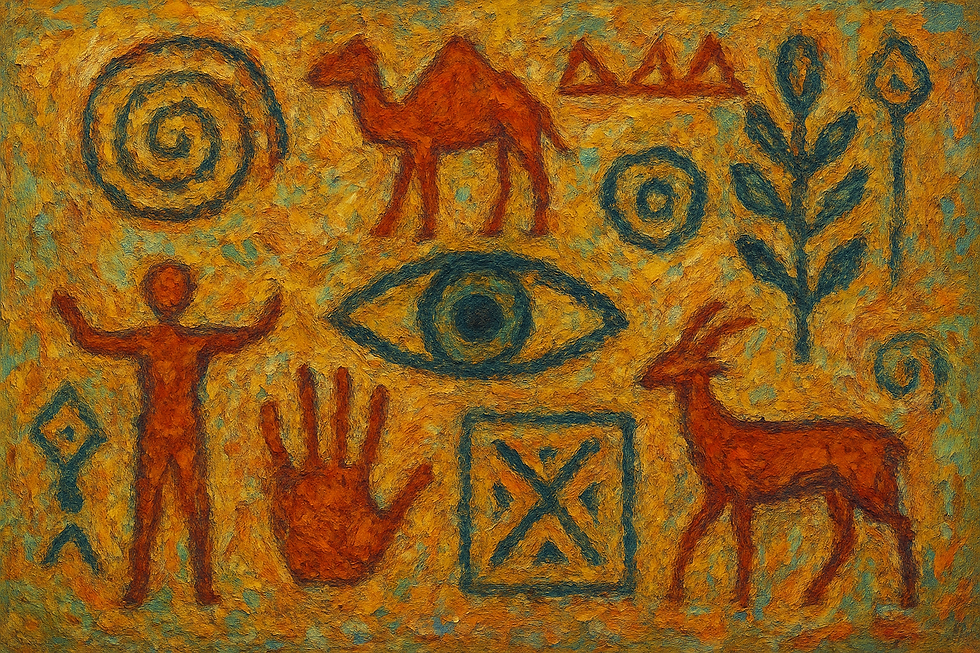
I have always been haunted by the question of the first sound that came from a human mouth, the first moment a human being used language. That primal sound through which one being tried to alert another to his presence, to say, “I am here.” What was he trying to express?
In an age before abstract thought or grand ideas, what did he want to convey?
Perhaps he did not intend to communicate a specific idea at all, but rather to share a universal feeling, to draw the other into the same existential moment, to make him see the beauty he himself saw. That first cry was not “language” in its modern sense, but a ritual, a call charged with an obscure emotional energy. From this origin, language was, at its core, a kind of magic.
Language is not merely a tool for expression; it is a spell woven from intertwined elements: sound, rhythm, breath, energy. Through letters, pronunciation, and the inner music of words, we can transmit something beyond meaning, a current that awakens consciousness. Language is music, and words are riddles to be experienced, transmitting feeling from one being to another. This is the miracle only humans can perform.
Yet today, language seems to have lost its ancient magic, its primal charge. Speech has become mechanical, severed from its original power. In that early time, each word was sacred, each letter a melody, and every utterance an act of creation.
The Primal Voice and the Birth of Energy
How was this vocal energy born? How did humans discover it within themselves?Two paths approach this mystery: myth and evolution.
Myth tells that humans discovered their voice suddenly, through divine inspiration—as in ancient Buddhist tales, whereas evolution describes a long process unfolding over millennia, through the development of the larynx, society, and language itself.
But the magical traditions of old cultures preserve remnants of this early awareness of sound. In ritual and incantation, we find attempts to harness the hidden energy of the voice. When a magician recites a spell, he relies not only on its meaning but on its tonal vibration, on the resonance the letters create.
In ancient Eastern languages, Hebrew, Arabic, Persian, which share deep phonetic roots, we can still sense this magic. A native Arabic speaker, when hearing Hebrew recited without understanding it, might still feel a familiar vibration. Meaning disappears, but the spirit perceives the pulse. Sound itself becomes a magical act, a primitive use of language as pure energy.
The Magical Use of Language: From Kabbalah to the Maghrebi Tradition
In Jewish mysticism, the Kabbalah represents the deepest form of esoteric thought, before it evolved into a system of spells and sacred formulas. It is built on the belief that the Torah existed before the creation of the world, and that its letters form the hidden structure of the universe. Each letter is an organ in the cosmic body; any disruption in their order threatens the harmony of creation.
According to legend, the Torah descended upon seventy nations in seventy languages, and each human being carries within him a letter of it, the core of his being. Over time, this idea evolved into the notion of cosmic cycles: each cycle spans seven thousand years, with its own Torah. Humanity now lives in a corrupted cycle, missing one vital letter—Shin—and this absence, they say, is the source of the world’s decay.
Thus letters became instruments of creation, and pronouncing them an act of cosmic significance. As symbolism turned to ritual, the magic of letters and numbers emerged, the foundation of Kabbalistic magic.
Iranian–Shi‘ite Roots
A parallel concept appears in Shi‘ite mysticism through the idea of Umm al-Kitab (“The Mother of the Book”), a hidden scripture that contains divine secrets. The Qur’an is the outward text for the many; Umm al-Kitab is the inner book for the initiated few. Letters here are not inert symbols, but vessels of power accessible only to those who reach higher levels of spiritual knowledge.
In Shi‘ite interpretation, each letter holds a secret meaning, and every verse multiple layers of symbolism. For instance, the phrase “Ḥā Mīm. By the Clear Book” was interpreted as: “Ḥā Mīm” represents Muhammad, “the Clear Book” represents Ali, and “the Blessed Night” represents Fatima. Such symbolic readings animate the text, transforming it into a living field of energy.
Cross-Cultural Influence
These ideas flowed from Shi‘ite mysticism into Jewish Kabbalah, and later into Islamic Sufism. Terms like Imam, Qutb, and Wali, all designating a mediator between the divine and the human—reflect this shared spiritual structure. When Maghrebi Sufis encountered Jewish mystics in Andalusia, a deep synthesis occurred, giving rise to new symbolic systems that intertwined letter, sound, and vision.
Conclusion: Studying Magic to Revive Language
To study magic is not to chase the supernatural, but to rediscover the energy once alive in language. When words became charms and incantations, they fulfilled their primal role—to create, to affect, to transform.
Though such usage may seem primitive, even distorted from pure mysticism, it restores to us an understanding of language as a living organism, pulsing with cosmic energy. The first word was not a tool of communication, but an act of creation.
As written in Genesis:In the beginning was the Word.And in the Qur’an:His command, when He wills a thing, is only to say to it “Be,” and it is.
The word is the first magic. The voice is proof that we are alive.
Eslam Yousef – Egyptian artist, writer, and director.
The opinions expressed in this article are solely the author’s and do not represent the views of Nisaba Media.


Comments